
Light can twist matter in unexpected ways
A new method reveals a hidden property of light that could power future nanomachines
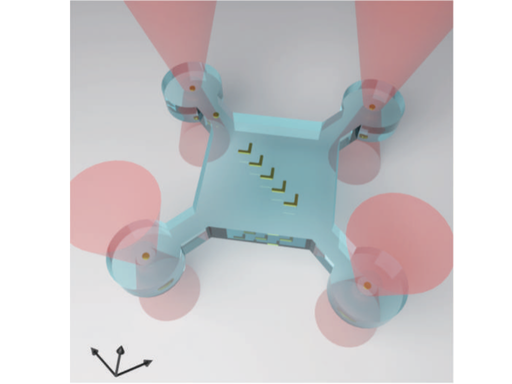
A “micro-drone” holds a nanostructure at its center, while four laser beams trap and control it. (Ryoma Fukuhara et al., Nature Physics. April 20, 2026).
Light does more than illuminate the world—it can also push and twist matter. It was back in the 1870s that James Clerk Maxwell first predicted that light carries momentum and can exert pressure on objects. Nearly a century later, in the 1970s, Arthur Ashkin asked why not use this property of light to hold and push around tiny particles. He developed optical tweezers that use focused laser beams to trap and move nanoscale objects.
While scientists have long known that light can exert small forces, detecting them has been extremely difficult. Objects at this scale are constantly jostled by random thermal motion, making the subtle influence of light hard to measure.
Now, researchers at Hokkaido University have developed a new method to measure these small forces with high precision. They then used the new technique to discover a surprising phenomenon in which light can twist tiny objects sideways, in a direction that is perpendicular to the light’s direction of travel.
“We developed a novel measurement platform called the ‘micro-drone,’ which enables, for the first time, full three-dimensional characterization of optical forces and torques acting on nanostructures,” says Professor Yoshito Y. Tanaka of Hokkaido University.
The idea is simple: place the nanostructure to be studied at the center of a tiny, cross-shaped platform, or “micro-drone.” Then use four laser beams to hold the platform in place, like invisible tweezers gripping its corners. By carefully tracking how the platform moves and rotates, researchers can then infer the forces acting on the nanostructure inside.
“Optical tweezers have been a powerful tool since Arthur Ashkin’s pioneering work, recognized with the Nobel Prize in 2018,” says Tanaka. “Using them, conventional methods could only measure rotation of an object along a single axis. Our approach overcomes this limitation by measuring not the nanostructure itself but the platform containing the nanostructure.”
The new method allows scientists to measure motion and rotation in all directions—capturing a complete three-dimensional picture. In effect, it converts extremely small, hard-to-detect nanoscale forces into larger, measurable movements of the micro-platform.
The team tested their approach using tiny gold structures shaped like the letter “V.” Using the new method, when these structures were placed inside the platform and illuminated with light, they exhibited an unusual behavior known as transverse optical torque, meaning that instead of twisting themselves along the direction of light, they rotated sideways.
“We were able to observe, using the new method, a phenomenon that had not been experimentally observed before: transverse optical torque acting at the nanoscale,” says Tanaka.
Even more surprising was what led to this effect. Scientists had predicted that such a twisting effect would be controlled by the light’s angular momentum. But instead, the researchers found that it depends on a more subtle property called optical helicity—a measure of the “handedness,” or twist of the light’s electromagnetic field. They showed this by designing experiments that canceled the light’s angular momentum while preserving its helicity. The sideways torque still remained, confirming that helicity plays the dominant role.
This discovery provides new insight into how light interacts with matter at extremely small scales.
It opens up new possibilities for using light to precisely control nanoscale objects. Potential applications include light-driven nanomachines and advanced sensing technologies.
“This work represents a new measurement paradigm for nanoscale optomechanics,” says Tanaka. “Just as optical tweezers opened a new field in single-molecule biophysics, we hope this platform will unlock access to nanoscale mechanical phenomena that have so far remained beyond reach.”
Original article:
Ryoma Fukuhara, Tsutomu Shimura, and Yoshito Y. Tanaka, Transverse Optical Torque observed at the Nanoscale. Nature Physics, DOI: 10.1038/s41567-026-03268-6.
Funding:
This work was supported by the JST FOREST Program (No. JPMJFR213O); Grants-in-Aid for Scientific Research (KAKENHI) (No. JP22H05132 in Transformative Research Areas (A) “Chiral materials science pioneered by the helicity of light” and No. JP21K14594); the Program for Forming Japan’s Peak Research Universities (J-PEAKS) (No. JPJS00420230001).
Contacts:
Professor Yoshito Y. Tanaka
Laboratory of Nanosystem Optical Manipulation
Research Institute for Electronic Science
Hokkaido University
Email: ytanaka[at]es.hokudai.ac.jp
Megha Kalra
Public Relations & Communications Division
Office of Public Relations and Social Collaboration
Hokkaido University
Email: en-press[at]general.hokudai.ac.jp