President’s Column #14: “Be Ambitious” or “Be Reckless”?
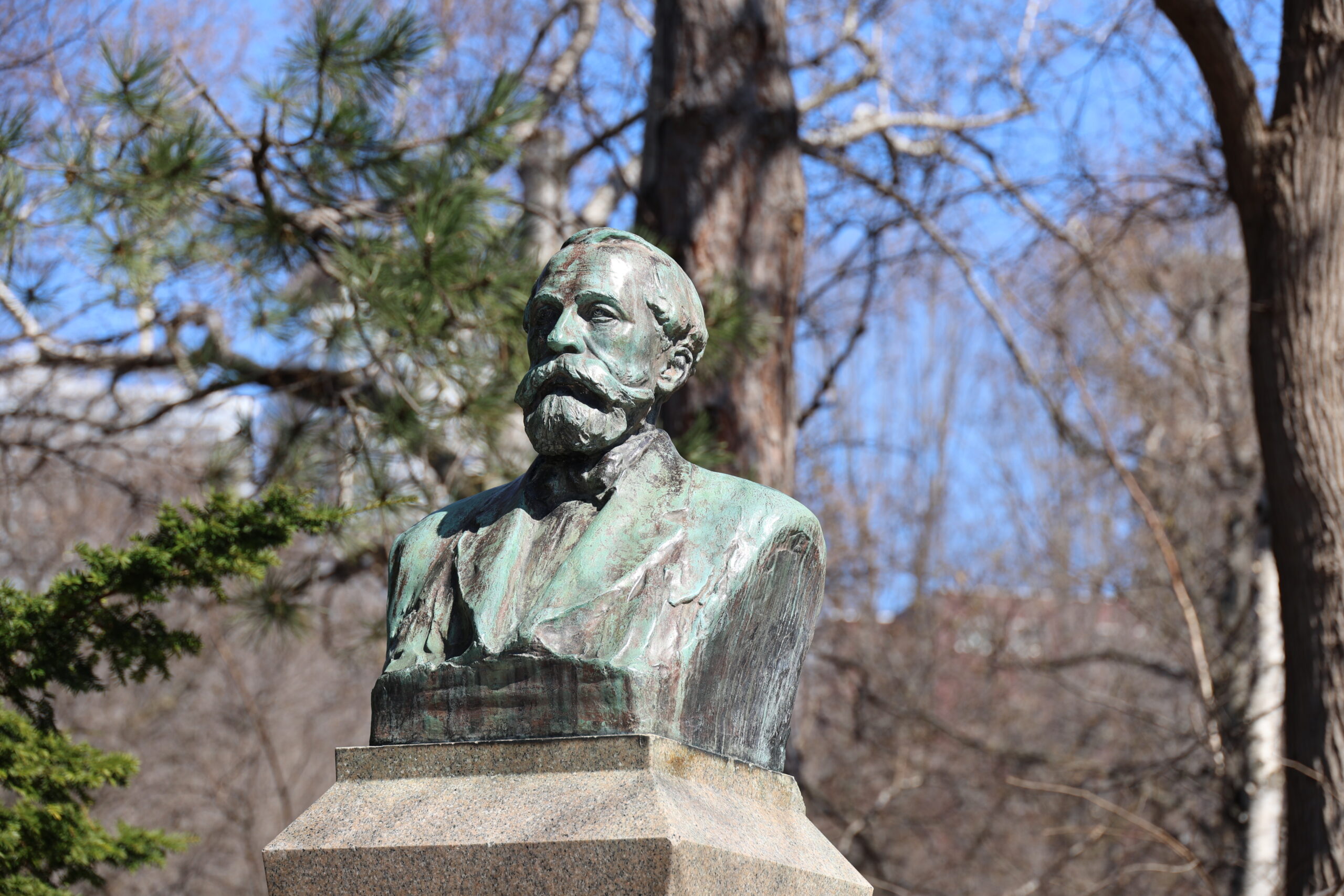
The signature phrase of Hokkaido University is “Be ambitious!” These are the words left to the students by Dr. William S. Clark, the university’s first vice‑president, when he left for his home country, the United States of America.
The word “ambitious” does not fit a modest, polite, or reserved way of life. Rather, it is suited to a bold spirit of challenge—one that dares to overreach and chooses an independent path instead of moving with the crowd. Such a life may bring great success, but it also carries the real possibility of great failure.

In fact, Dr. Clark himself chose an exceptionally ambitious path. He left one of the leading universities in the United States to take on the challenge of helping to establish a small university at the northern edge of a far‑eastern country. After returning to the United States, he even attempted to start his own business, but that challenge ultimately ended unsuccessfully, and records show that his later years were difficult. In every sense, he lived an ambitious life—his actions truly matched his words.
The other day, an old acquaintance of mine suddenly came to my office. He had left his university professorship before reaching the mandatory retirement age and moved to the United States with his family. He was already past sixty, and moreover, he had never studied abroad. With no job prospects and hardly any acquaintances there, their family crossed the Pacific Ocean and headed for the East Coast. Not only was he himself, but his entire family was fearless, ambitious people.
Looking at the current situation in the United States, their decision seems almost like reckless bravery. Yet he told me that they simply believed in the possibilities America offered. Their journey was reminiscent of the Puritan settlers who migrated to America in its founding era.
Naturally, there was no chance of finding the kind of professional position he had once hoped for. Above all, the language barrier was enormous. Acquiring practical English skills after the age of sixty is almost like replacing the operating system you have used your entire life—it is nearly impossible. Without the ability to communicate, no matter how outstanding one may be in academia or technology, one simply cannot gain recognition in the United States.
He had no prospect of securing a stable academic position, and as his financial situation became difficult, he applied for more than fifty part‑time jobs. Eventually, he managed to sustain his livelihood by washing dishes at a Japanese restaurant and working at a conveyor‑belt sushi shop.
Even so, his career and achievements in Japan were recognized, and he was eventually granted a green card. It is true that the United States is currently struggling with issues surrounding immigration, but it also has a long history of accepting diverse people. This openness and capacity for diversity are something Japan lacks entirely.
In Japan, the mandatory retirement age is sixty or sixty‑five, but in the United States, where age barriers are much lower, it is common not to list one’s age on a résumé. When people speak of “brain drain,” attention tends to focus on young, brilliant researchers full of promise. Yet when a highly capable, challenge‑driven scholar in the prime of life leaves Japan, that too is undeniably a form of brain drain.
Compared with this courageous professor, I cannot help feeling that I myself still fall short in both the spirit of challenge and any real ambition; at times, I seem like a timid person, far removed from anything that could be called ambitious.
Of course, I cannot suddenly resign from my position as university president and move overseas. Still, I believe that an ambitious way of life is, by nature, a fierce one, and it seems to me that Dr. Clark urged his students to live precisely in that way. As president, I must strive to follow that example in my own way.