

The Office of Ainu Relations and Initiatives (OARI) was established in April 2022 to promote a community marked by respect for the pride of the Ainu people. OARI functions to design and implement initiatives within the University that foster mutual understanding and respect between the Ainu community and other members of the University, both on campus and within the broader community.
Our university office is the first to have an Ainu name, aynu sisam urespa ukopirkare us i, thanks to collaboration with Ainu language experts. It means “a place where the Ainu people and university members of all backgrounds, including ethnic Japanese, can nurture and improve each other’s lives”.
The office is currently conducting a concrete study on how to create a safe environment for Ainu students and faculty members and deepen the understanding of the Ainu people among non-Ainu students and faculty members. In addition, in accordance with national policy, we are working on the return of Ainu ancestral remains and funerary objects housed in our university.
In line with the national government’s recent enactment of Ainu policies, such as the 2019 Act on Promoting Measures to Achieve a Society in which the pride of Ainu people is respected, we will promote initiatives that are unique to universities.
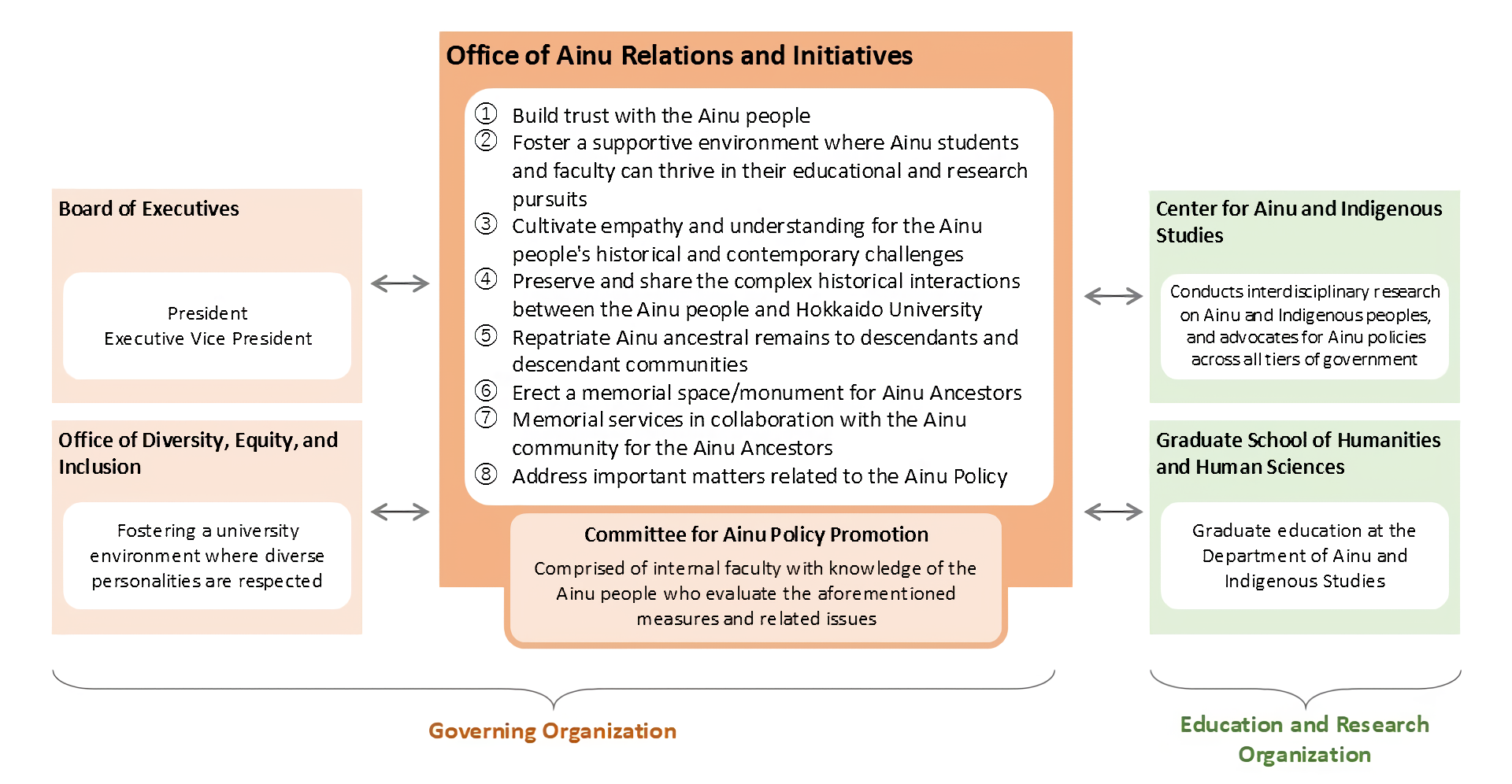
Our Initiatives
Educating Students
We provide a course on the historical relationship between the Ainu people and the University and the importance of respecting ethnic diversity as part of a compulsory undergraduate general education course. Starting in the academic year 2024, we will also contribute to a graduate school course to ensure all incoming students gain a deeper understanding of the Ainu people, regardless of their academic program or level.
Training Faculty and Staff
Since 2021, our office has been conducting annual training sessions to deepen the understanding of the Ainu people among faculty and staff. We expanded the target audience to include part-time staff. We believe that by deepening the understanding of the Ainu people among all faculty and staff, we can create an environment where students and faculty members of Ainu descent can safely and securely focus on their studies, education, research, and work.
You can see past training videos (internal only).
Promoting Ainu culture on campus
By providing opportunities to learn about and experience Ainu culture on campus, the office not only increases the visibility of Ainu culture within the university community but also helps create a more inclusive and safe space for everyone with Ainu ancestry. Ainu culture encompasses a wide range of aspects, including language, lifestyle, oral traditions, crafts, artwork, music, dance, cuisine, archaeological remains, traditional ceremonies, and other cultural practices of Ainu society in the past, present, and future. We have gradually implemented various initiatives, such as Ainu language announcements on the campus shuttle bus the inclusion of Ainu names for campus facilities on campus guide maps, and Ainu food fairs at university cafeterias.
Imparting History and Memory
In a 2019 statement, then-acting President Masanori Kasahara stated that the university would establish a memorial that stands as a testament to the legacy of the relationship between the university and the Ainu people and continue its longstanding duty of hosting memorial services following the repatriation of Ainu ancestral remains and funerary objects housed at the university. We are committed to creating a space dedicated to remembering and sharing the collective memory of the university’s historical interactions with the Ainu community, including its past failings in respecting their dignity.
Background Report
- Report on Initiatives in FY2022- (in Japanese only)
- Report on Initiatives in FY2023– (in Japanese only)
- Report on Initiatives in FY2024– (in Japanese only)
Statement of Respect for the Indigenous People of the Land on Which Hokkaido University is Located
The land on which Hokkaido University is located is a place where the Ainu people, the Indigenous people of this region, have long lived and carried out their livelihoods. Hokkaido University expresses deep respect for the fact that the Ainu people have maintained a long history and cultural connection with this land. In order to convey and pass on this historical background, the University has published the “Statement of Respect for the Indigenous People of the Land Where Hokkaido University Is Located” (Full Version / Summary Version).
The Statement consists of a Full Version, which describes in detail the historical background between the land on which the University’s campuses are situated and the Ainu people, and a Summary Version, which presents the key points in a concise form so that members of the University can easily use it in ceremonial greetings and similar occasions. Each version has been prepared in Japanese, Ainu (Ishikari River dialect), and English. In conjunction with the publication of this Statement, a plaque displaying the text in Japanese, Ainu (Ishikari River dialect), and English has been installed on the Hokkaido University Facilities Guide located on the right-hand side after entering the Main Gate of the Sapporo Campus.
Hokkaido University is expanding its initiatives to promote the use of the Ainu language on campus. Providing opportunities to engage with Ainu culture within the campus contributes to ensuring an environment in which members of the University who have roots in the Ainu people can carry out their activities with peace of mind while maintaining their own culture.
At the same time, it is also expected to provide other members of the University with opportunities to experience the culture of the Ainu people and the diversity of the University. Efforts to promote the Ainu language are expanding both within and outside the University. In the preparation of this text, the University received the cooperation of three individuals with roots in the iskarunkur (Ainu people who live along the Ishikari River and its tributaries), and these three individuals played a central role in creating the Ainu-language version.
Through the “Statement of Respect for the Indigenous People of the Land Where Hokkaido University Is Located,” Hokkaido University promotes understanding of, and the passing on of, the history and the present of the Ainu people—the Indigenous people of this land—among members of the University who do not have roots in the Ainu people as well. Through this, the University aims to become an institution in which both members with roots in the Ainu people and other members can feel secure and can study and work together in a safe environment.
Furthermore, Hokkaido University will endeavor to extend these ideas and actions from the University to society at large, and will devote itself to the creation of a coexisting society in which people with roots in the Ainu people and people of other backgrounds can live together with peace of mind.
Summary Version (English)
The Summary Version is intended for use in greetings at events hosted by the University and in public relations materials. If coordination or adjustments are required, please contact the Office of Ainu Relations and Initiatives.
Anti-Discrimination
In the 2021 Hokkaido University’s Statement on the Promotion of Diversity and Inclusion, the University affirms its commitment to upholding the dignity of all its members, regardless of race, language, ethnicity, or other factors. The University also pledges to promote awareness, reform, and environmental improvement to achieve a bias-free campus. In 2023, the President expressed the University’s commitment to addressing inappropriate and exclusionary statements, especially those concerning ethnic minorities, including the indigenous Ainu people.
The University has a long history of welcoming students and faculty members from diverse ethnic backgrounds, including the Ainu people. Ensuring that these students and faculty members can work and study in an environment free from discrimination and prejudice is not only essential for their well-being but also a critical responsibility for the University as a whole. Such an environment benefits all members of the University community and is essential for fostering a truly inclusive and welcoming campus.
According to a national survey on discrimination and prejudice against the Ainu people conducted in 2008, 70% of Ainu respondents answered that there is currently discrimination and prejudice against the Ainu people. In order to realize a campus free of discrimination and prejudice, it is important for each member of our university to be aware of prejudices, biases, and stereotypes against the Ainu people and to act in a way that does not create a hostile environment.
We have compiled information on how to prevent racial harassment, which the University defines as discriminatory speech or behavior based on ethnic background, with a particular focus on discrimination against the Ainu people. Please see the materials below for more information. The document is intended to raise awareness among all members of the university community in order to prevent racial harassment at our institution. Additionally, we have created an educational pamphlet based on this material, and are working to make this information easily accessible to university members and other stakeholders.
Official Statements Regarding the University and the Ainu People
- 2005 Statement by Former President Mutsuo Nakamura (in Japanese only)
- 2019 Statement by Former Acting President Masanori Kasahara (in Japanese only)
Repatriation of Ainu Ancestors
For more information, please visit the information page (in Japanese only).
Contact
urespa-ukopirikare[at]general.hokudai.ac.jp
(Please replace “at” with @ and remove all spaces)