
Graduate Degree Commencement Ceremony – Farewell Address (March 2026)
Farewell Address by Hokkaido University President Kiyohiro Houkin
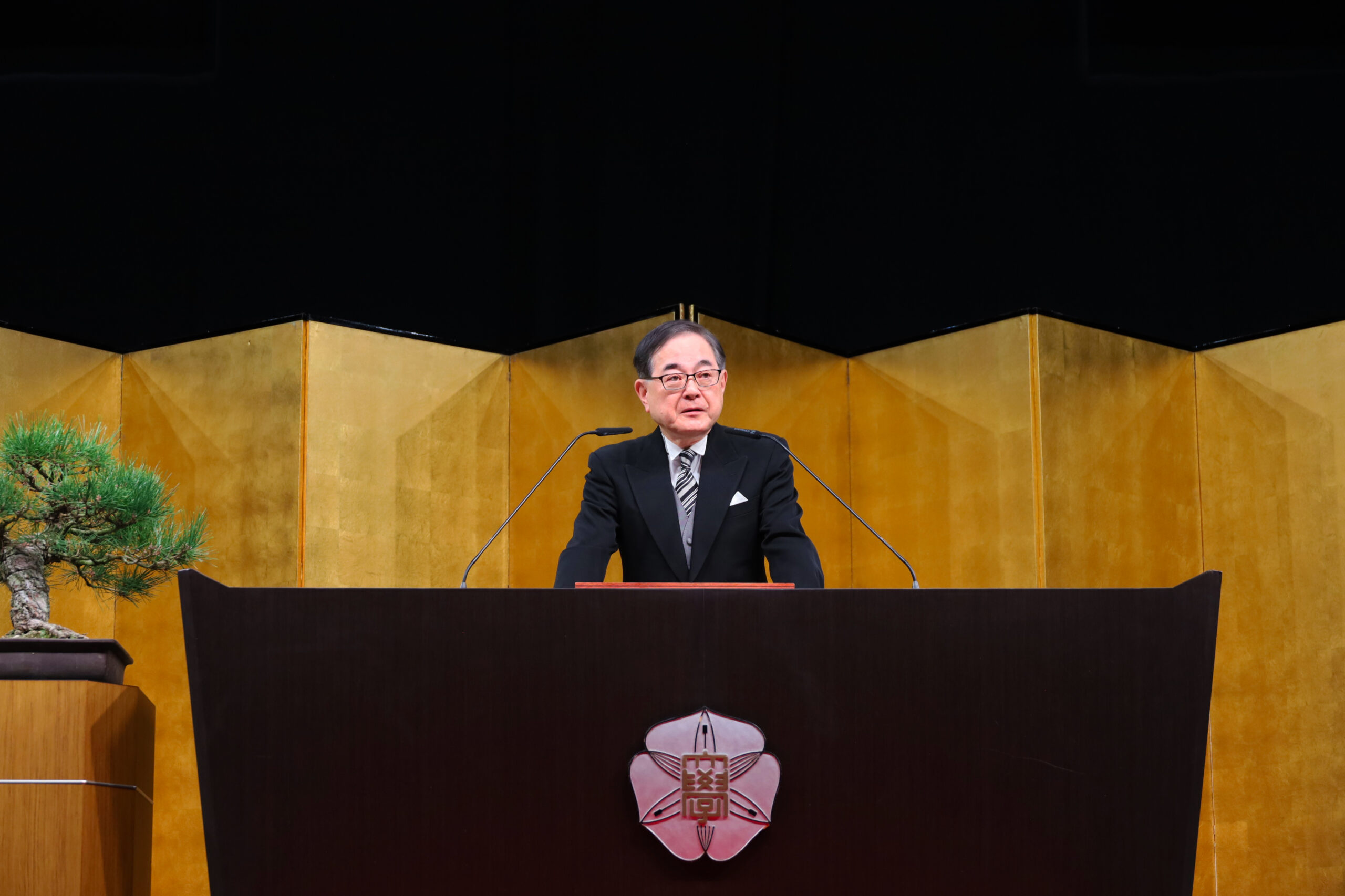
Congratulations to the 1,938 students receiving their degrees today. On behalf of Hokkaido University, I extend my heartfelt congratulations to all of you who have completed your master’s, professional, or doctoral programs. Allow me to also express my deepest gratitude to the families, guardians, mentors, and all others present who have supported these graduates along their journey. Congratulations to you for seeing them through to this momentous occasion.
I would also like to extend my heartfelt congratulations to our 295 international students, who have persevered through their studies here. Pursuing a degree in a foreign country requires extraordinary effort, and I hold deep respect for your dedication and perseverance.
Additionally, I would like to express my sincere thanks to everyone who has supported the University during this time.
Today, along with the long-anticipated celebrations of degree conferment, I would like to take a moment to touch upon the meaning of academic degrees and higher education in our current world.
As an entity, the university in our present society is granted the authority to offer high-level, high-quality education to its students. This fundamental mission involves supporting research and evaluating its results, while providing suitable academic content to cultivate competent degree holders. This puts the university in a central and powerful position and burdens it with the heavy responsibility of shaping those who will shape the future of our world.
This also places significant weight on the shoulders of all degree holders who pass through the halls of institutions of higher education, that is to say, all of you. Will the decisions you make as you take the helm drive our society into confusion and despair, or will you rise to the occasion to advance efforts in creating a society of well-being for future generations?
At present, Japan sits comfortably on thousands of years of history, a history that has seen steady population growth, with a near explosion happening just after the Meiji Restoration. The world saw this growth and still carries its effect, as seen in the current global population of 8 billion people and counting. It has even been predicted that by the year 2080, our world will be home to over 10 billion souls.
Yet, as I’m sure you are all keenly aware of as participants in the Japanese society of today, the trend of upwards growth has taken a drastic turn to population decline. Our society has come a long way from the time of the Meiji Restoration and has seen both the flourishing of expansion and development. However, we are standing now on the edge of a time where some course corrections need to be made for us to successfully move forward. There have already been many models proposed, yet at present, they are not enough to clarify the road ahead, and it will be up to you to continue efforts to take on the current social situation(s). Today, as your degrees are conferred and you face the consequences of what previous generations have passed down for you to shoulder, we are witnessing the beginning of a new era to be determined by a new generation.
On top of the issues close to home, in recent years, we have seen the world at large wrapped up in dramatic changes. First, in the past few decades, the issue of climate change and threats to environmental sustainability have been brought into sharper focus. Equally concerning, geopolitical tensions have also been heightened, and we have not yet found a path to peace and global security.
Meanwhile, impressive advancements and innovations in science and technology have brought forth the advent of generative AI, but this discovery raises many questions that force us to examine what it means to be human. While at the same time, the lessons our forefathers passed down to use through history on humanitarianism and diversity are being called into question. Amidst all these changes, it has become difficult to envision exactly how a society of well-being may be created.
Looking at the world in this way, we see that our era is overshadowed by a new kind of fundamental anxiety: Japan’s population decline, shifting values around the world, concerns about sustainability, and the challenge that artificial intelligence poses to human intelligence. Uncertainty about the future now pervades the world.
But what has been made clear is that our current point in history is more of an “era between eras,” and the decision for how we will move forward into the next is being entrusted to all of you as you are conferred with your degrees today. You are the frontrunners paving the way to the future of our society.
And as frontrunners, the future of our world and Japan, regardless of the changes I have mentioned and no matter how uncertain or unclear the future may seem, I believe is being placed into capable hands. Hands that will use the knowledge and resilient adaptability gained here to lead us into the realization of a society of well-being.
This year marks the 150th anniversary of the founding of Hokkaido University. The phrase we have selected to represent what we believe to be an overarching theme of these past 150 years is “Light comes from the north.” “Light,” of course referring to each and every one of you here today. To me, I believe the natural continuation of this phrase would be “lighting up the world.” “Light comes from the north, lighting up the world”. Each individual here is a ray of light shining into the corners of their lives, but when brought together, there is enough radiance to illuminate the world. I look forward to seeing your lights from the north lighting up the world.
Finally, I would like to close off my remarks today by remembering the first vice president of Sapporo Agricultural College, whose legacy has been etched forever in the history of this university: Dr. William S. Clark. I believe that although he lived 150 years ago, his life and philosophies can still be a significant inspiration to us living in the present realities of 2026.
One hundred and fifty years ago, in 1876, Dr. Clark responded to the request of the Meiji government to cross the American continent, sail the Pacific, and then, with 13 students who had studied English in Tokyo, make his way to Hokkaido. At the time, the Meiji government was still in the grips of instability, and with the geopolitical climate in the Far East, the path forward was more obscured than ever.
Accomplishing his mission to lay the foundation of Sapporo Agricultural College, he left Sapporo with these words: “Boys, be ambitious, like this old man!” This simple yet profound sentiment pierced the hearts of his students and left a lasting impression.
We can clearly see that he faced many challenges throughout his life. Beyond his devotion to academics and education, he continuously strived to change the world and society. True to his words, he led a life full of ambition and daring.
Thanks to the legacy left by Dr. Clark and the teachers who accompanied him, individuals such as Inazo Nitobe, Kanzo Uchimura, and Kingo Miyabe carried on the torch as embodiments of the successful development of global leaders. You here are the next bearers of this torch, successors who carry on the DNA of ambition, just as these men did.
It is my hope that all of you will take up the mantle of our great role model, Dr. Clark. I urge you to boldly venture into this age of uncertainty with a spirit ready to “be ambitious” in your hearts and the bravery to continue learning and facing challenges. I would like to conclude my remarks by wishing all graduates great health and success in their future endeavors. Once again, congratulations to all!
※The farewell address in Japanese for the bachelor’s degree graduates can be found at the following link: https://www.hokudai.ac.jp/president/greeting/23.html