
Study reveals how individual cells ‘surf’ chemical waves to form a collective
Joint press release from Hokkaido University, the University of Tokyo, the University of Osaka, and Tokushima University
Researchers have developed an innovative imaging technique to visualize the transition of single cells into multicellular organisms in new detail.
Some of the body’s most important processes are driven by collective cell movement: immune cells swarm to fight infection, skin cells race to close a wound, and tumor cells advance together as cancer spreads. But until now, how individual cells fall into step as a group has been unclear.
In a study published in Scientific Reports, researchers from Japan, Germany, and Bangladesh have developed an imaging technique that shows how individual cells behave, moment to moment, as they shift from acting alone to moving as a group.
The team used the single-celled, soil-dwelling amoeba, Dictyostelium discoideum, as a model of collective movement. When there are no bacteria to eat, starved amoebas release a chemical signal, cyclic AMP (cAMP), which prompts the cells to move together and form a multicellular organism. This helps them survive difficult conditions.
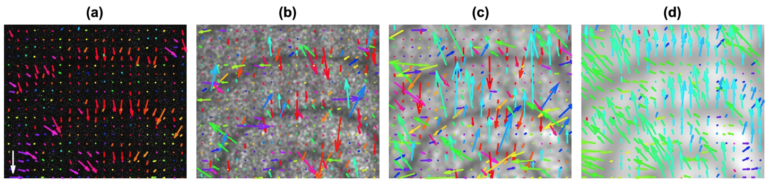
Previously, studying this aggregation meant tracking individual cells — difficult once they start crowding together — and separately measuring the cAMP wave’s direction.
“How individual cells read passing waves of chemical signals and translate them into coordinated group migration has been hard to pin down,” says Professor Tamiki Komatsuzaki of Hokkaido University, who led the study.
The team used fluorescent imaging to track cell movement and cAMP levels simultaneously, frame by frame. They blurred these images by different amounts and then applied particle image velocimetry — a technique for tracing the flow of fluids — to each blurred version. Sharp images reveal individual cells’ paths, while blurring averages out each cell’s small, jittery movements, revealing the larger, smoother pattern of the cAMP wave itself. This let the researchers directly compare wave dynamics and single-cell movement throughout the experiment.
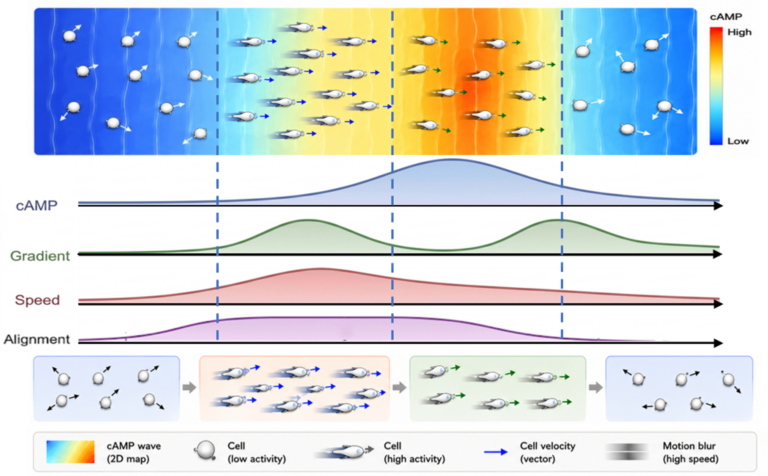
The team tracked the cells continuously from two to seventeen hours after the onset of starvation and saw that, as a wave approaches, cells surge to meet it almost head-on. But when the wave crests and begins to recede, the cells don’t reverse to chase it. Instead, their motion stays locked in the same direction; then they rest, directionless, in the troughs until the next wave arrives, and the cycle repeats.
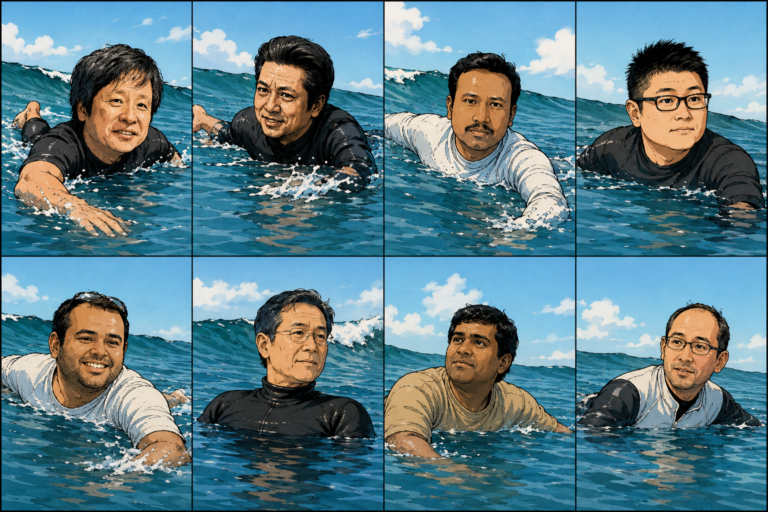
“It’s like watching a crowd of surfers paddle hard to catch a wave, ride it together, and then bob around waiting for the next one,” says Komatsuzaki.
The findings offer what the authors say is the first systematic map of how the amoebas’ collective behavior emerges from individual action. The team believes their imaging technique could help decode collective cell movement far beyond amoebas — including identifying which cells are the ‘leaders’ and ‘followers’ within a developing wave — and inform future research into immune responses and cancer biology.
Original article:
Sattari et al., Collective surfing of single cells on a chemo-attractant wave using multiscale Eulerian velocity vector field. Scientific Reports. 18 July 2026.
DOI: 10.1038/s41598-026-61774-2
Funding:
This work was supported by the Grant-in-Aid for Scientific Research on Innovative Areas “Singularity Biology (No. 8007)” (grant numbers 18H05413, 18H05410, 18H05415, and 19H05416), MEXT; JST CREST (grant numbers JPMJCR1662 and JPMJCR2333); the Research Program of “Dynamic Alliance for Open Innovation Bridging Human, Environment, and Materials” in the “Network Joint Research Center for Materials and Devices” (grant numbers 20191062-01 and CORE2-A 2022C004); and JSPS KAKENHI (grant numbers 23H00384, 25K02232, 22654047, 25610105, and 25H01363). Udoy S. Basak also acknowledges support from the Alexander von Humboldt Foundation.
Contacts:
Tamiki Komatsuzaki
Research Institute for Electronic Science
Hokkaido University
Email: tamiki[at]es.hokudai.ac.jp
Megha Kalra
Public Relations & Communications Division
Office of Public Relations and Social Collaboration
Hokkaido University
Email: en-press[at]general.hokudai.ac.jp