
President Column #17: Mishearing English
I have been exposed to English for more than sixty years, ever since I entered junior high school, and yet I still often mishear “can’t” as “can,” or vice versa. Failing to catch the word “not” can lead to a complete reversal of meaning. Many Japanese people have difficulty hearing this crucial “not.” I have seen, more times than I care to remember, questioners and speakers talking completely past each other during Q&A sessions at academic conferences.
Understanding the lyrics of English songs is perhaps the greatest challenge of all. Akina Nakamori, a very famous Japanese singer, had a hit song called DESIRE -Jōnetsu-. One of its memorable lines is “Get up, Get up, Get up, Burning Love.” For a long time, however, I heard it as something like “Geru, Geru, Geru, Maria,” and wondered what on earth it could possibly mean.
The “Get up” part is not so difficult once you know that the “t” can become what is known as a flap t in American English, producing a sound somewhat like an “r.” Perhaps such features of American English pronunciation are systematically taught today, but my generation had never been taught them properly.
As for why “Burning Love” sounded like “Maria” to me, there is almost no linguistic explanation. It was simply a classic case of mishearing. I even found myself strangely impressed, wondering why the Virgin Mary had suddenly appeared in the middle of the song.
Fortunately, I occasionally have my little grandson over as well. He has only just started kindergarten but is already learning English from native English-speaking teachers. His pronunciation is impeccable. The distinction between “R” and “L,” in particular, is so beautifully clear that I could listen to it all day. Sometimes he says something in English with pronunciation that I cannot even understand. Realizing that I have failed to understand, he gives me a look that seems to say, “There’s no point talking to this person.” Being given up on by a three-year-old is rather humiliating.
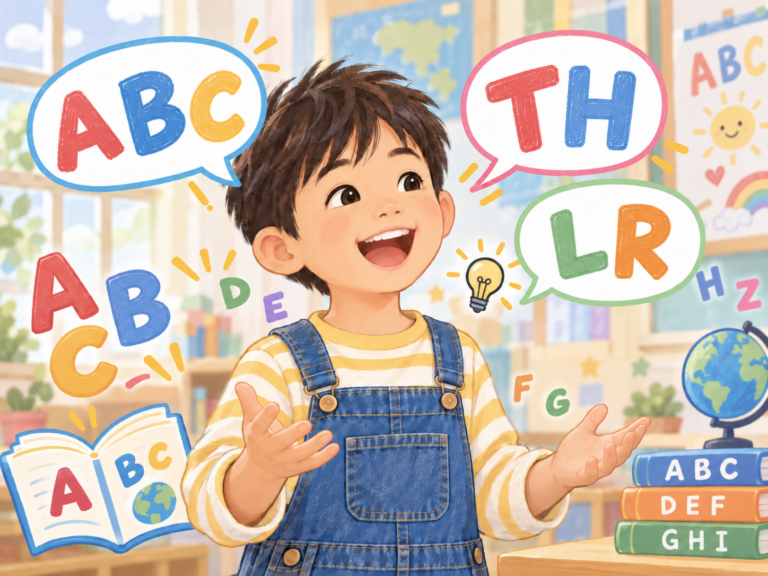
My generation first encountered English in the first year of junior high school, some sixty years ago. Looking back, the way English was taught in those days was, frankly, dreadful. I remember being shown cross-sectional diagrams of the human head illustrating the position of the tongue and being made to memorize how to distinguish “R” from “L” and how to pronounce “TH.” Several classmates seemed to develop a dislike of English simply from having to stare at those rather disturbing diagrams.
Learning takes different forms. Some learning, such as acquiring the ability to listen to and speak a foreign language, involves physical and perceptual skills and in that sense resembles learning a sport. This belongs broadly to the psychomotor domain. Other forms of learning, such as mathematics and logical reasoning, belong primarily to the cognitive domain.
At least in its skill-based aspects, learning English is rather like learning a sport. And in that respect, sad to say, there are already areas in which I am completely outclassed by a three-year-old.
Higher education has often placed disproportionate emphasis on the acquisition of knowledge and on cognitive learning. Put differently, I believe that skill-based learning has tended to be undervalued. One reason for the relatively limited English proficiency of my generation may well have been this neglect of learning through repeated practice and the acquisition of practical skills.
Now that universities are entering the age of AI, I believe it is time for us to reconsider the importance of skill-based learning.