

This article was published in Japanese in Litterae Populi magazine (Spring 2026, Vol. 76)
Always keeping our spirit of striving and adventure alive, we want to deliver confectionery from Hokkaido to the world.
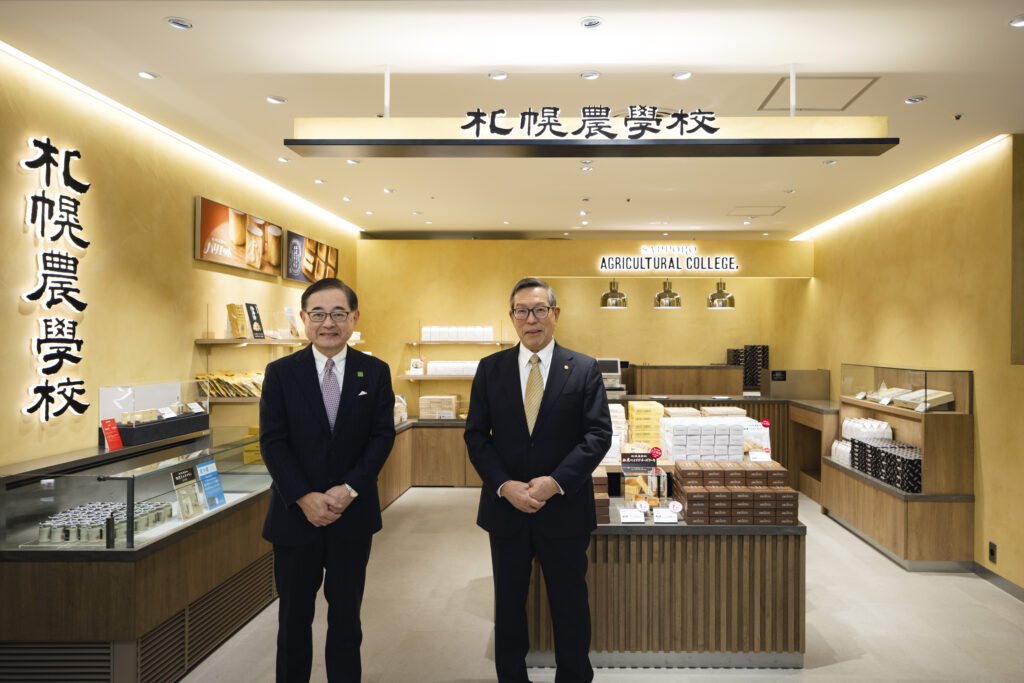
Mr. Akio Naganuma founded the beloved Sapporo confectionery KINOTOYA and chairs the Hokkaido Confect Group. The group produces and sells a variety of sweets and develops ingredients at environmentally regenerative farms. He ventured into the unfamiliar confectionery industry, carved out a market, and in 2025 opened the first store of the Sapporo Agricultural College brand in a department store.
President Kiyohiro Houkin, who’s driving reforms toward creating an unparalleled university, spoke with Mr. Naganuma about the company’s growth journey, its connection with Hokkaido University surrounding the birth of Sapporo Agricultural College’s Hokkaido Milk Cookies, and its prospects with an eye toward overseas markets.
Akio Naganuma
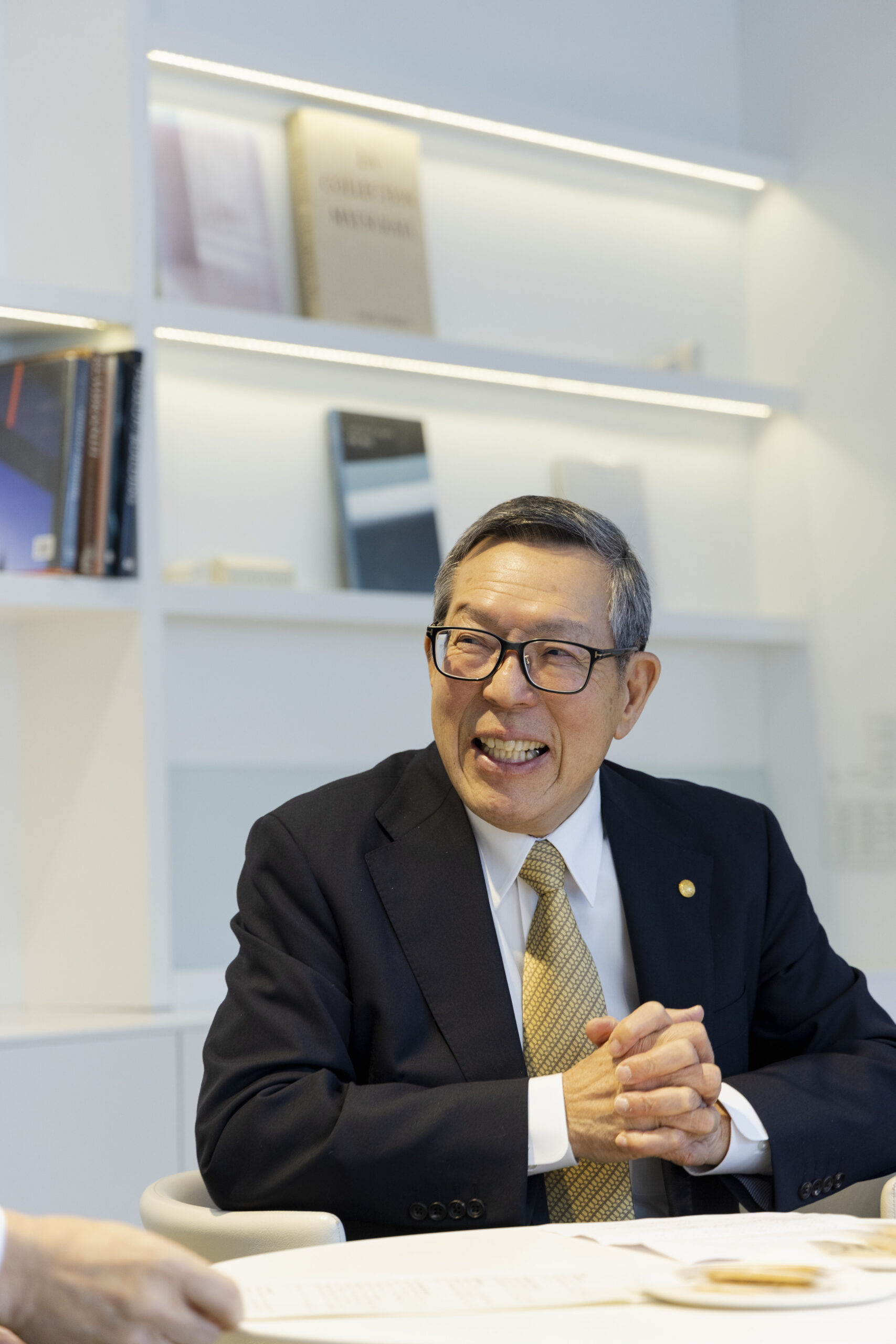
Born in 1947 in Hokkaido. Graduated from the School of Fisheries Sciences, Hokkaido University. Founded the Western confectionery company KINOTOYA in 1983. Incorporated KINOTOYA in 1985 and became President and Representative Director. Expanded the business from a cake shop to the Hokkaido souvenir industry, launching Sapporo Agricultural College’s Hokkaido Milk Cookies in 2005. Became Chairman of the Board in 2015 and Chairman of the Board of Directors at Hokkaido Confect Group Inc. in 2022 (current position). Using sales from Sapporo Agricultural College, he supports greening efforts at Hokkaido University’s Sapporo Campus and has established the KINOTOYA Scholarship and Hokkaido Confect Group Scholarship Overseas Study Support to aid students.
Working at a ranch in Niikappu after graduating from Hokkaido University
Houkin: Chairman Naganuma, you’re originally from Sapporo, right?
Naganuma: Yes, from Kotoni in Sapporo. My mother’s family were settler soldiers, and I’m the fourth generation. My father was from Nagano. He came to Hokkaido at the age of 19 and met my mother while he was working at an agricultural experiment station, and they got married. I am the youngest of six siblings.
Houkin: Six siblings?
Naganuma: My father passed away when I was in junior high school. My mother raised all six of us by herself, so our home was very modest. She passed away the year I graduated from university. My requirement when choosing a university was that it had to be a national or public university that I could commute to from home. I took two years off before entering the Hokkaido University School of Fisheries Sciences and was able to attend only thanks to a scholarship.
Houkin: I heard you skied during your student days.
Naganuma: I belonged to the mountain skiing club and spent about 100 days a year in the mountains. The club had a unique culture, including traditions like calling a schoolmate who was your senior you’d never met, and asking to stay at their place. The connections between older and younger members were incredibly strong. That’s where I made lifelong friends.
Houkin: Today, universities are redefining their value as AI and online technologies become an integral part of teaching and learning. Amidst this, extracurricular activities are still considered highly valuable.
Naganuma: At Hokkaido University, diverse students gather from all over Japan and the world. The question is how to build connections with them. Relationships formed during university last a lifetime, so I strongly encourage students to actively participate in activities.
Houkin: That’s a wonderful message that only someone with personal experience could convey. Mr. Naganuma, your career path after graduation was also quite unique.
Naganuma: Back then, I had a senior who was 15 years older than me, and he’d been on the mountain skiing team and was working as a veterinarian in Niikappu Town, Hidaka District, while running a chicken farm. That person gave me an invitation, saying, “After your graduation, let’s build a utopia together.” I didn’t even take any job interviews. I loaded all my possessions into a Jeep and moved deep into the mountains, more than 20 kilometers from the center of Niikappu.
Houkin: That’s quite a story (laughs).
Naganuma: When people hear Hidaka, they often think of horse ranches, but the mountainous areas are dairy farming regions. We developed a business model: Buy newborn bull calves, raise them on our own pasture for a year, then sell them to businesses on Honshu, the main island. But it didn’t work out. We kept at it for four years, but it wasn’t financially viable, so I eventually left.
Houkin: Back then, I think the word “sustainable” was still almost unheard of at that time. But was that where your original thoughts about sustainable agriculture and food began?
Naganuma: You’re quite right. Back then, our goal was to “create a new vision for agriculture.” More than fifty years have passed, but that aspiration remains unchanged. After returning to Sapporo from Niikappu, I got a job through a friend’s introduction. That company ran Bankei Ski Resort and a yakitori restaurant, and I was tasked with processing spent hens that had stopped laying eggs. Later, I was put in charge of managing a new izakaya that the company started. Offering all-you-can-eat shell-on scallops from Tokoro Town and all-you-can-drink beer was a huge hit.
Houkin: So, you stayed involved with food there too. Still, I see you always chose paths that differed from the ordinary ones.
Naganuma: I wanted to be a normal person too (laughs). So, at 29, I joined Hokkaido Daiei, which ran supermarkets. I worked for five years as the produce section manager, then quit when I was offered a transfer to Honshu.
Starting a confectionery business with no experience
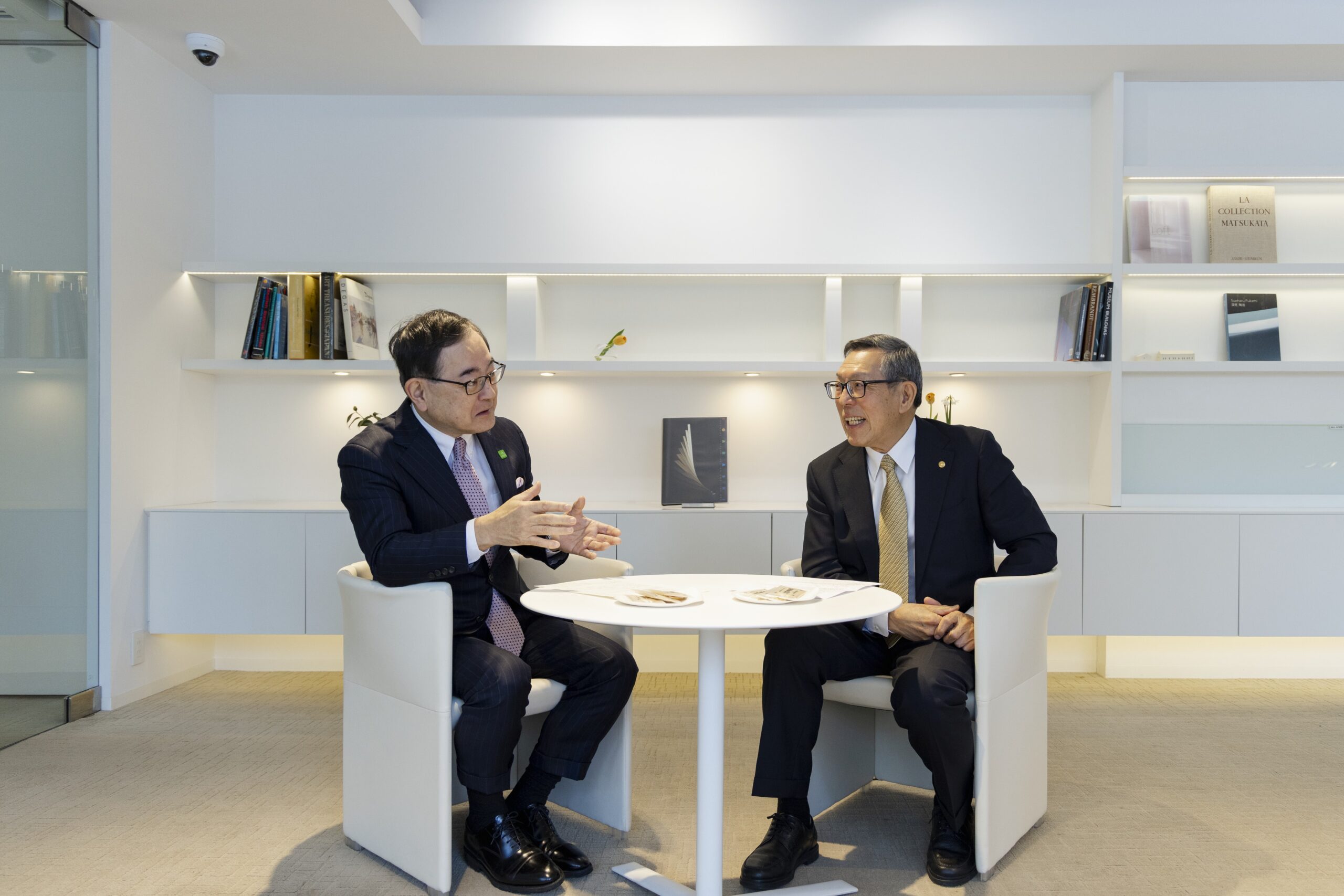
Houkin: When you started your business, why did you choose confectionery?
Naganuma: My wife’s father, who supported my startup, said, “A confectionery shop is a good business, isn’t it? Customers who come to buy sweets all look happy and joyful.” I thought, “he’s right.” Even though I had no connection to that world at all.
Houkin: So, you just started. That’s amazing. It must have been tough without any experience.
Naganuma: Initially, I planned to buy confectionery products and resell them. So, in July 1983, I founded Kinotoya at the current location of our Shiroishi Main Store. But nothing sold at all. About half a year later, by chance, I met Tadao Kato, who was working as a pastry chef at thriving shops in Otaru and Sapporo. He created Kinotoya’s sweets from scratch. That experience made me think, “I should sell what I personally find delicious,” and I started determining flavors from the consumer’s perspective.
“Perhaps what’s worked best has been our unwavering commitment to selling only what I find delicious.”
-Akio Naganuma
Houkin: What’s the meaning behind the shop name: Kinotoya?
Naganuma: My father-in-law, who encouraged me to open a confectionery shop, is from Niigata. He told me about a shop called Kinoto Manjuya that had been operating for more than 200 years in front of Oppou-ji Temple in his hometown. He suggested using “Kinoto” for the name. I added the “ya” to make it “Kino-to-ya.”
Houkin: And then in 2005, you shifted from focusing on fresh sweets to producing baked goods for souvenirs. What led to that decision?
Naganuma: In 1997, our shop experienced a food poisoning incident. At that time, I deeply realized that relying solely on fresh cakes would not ensure stable business operations. While thinking about creating sweets with a longer shelf life that tourists could take home as souvenirs, I recalled that there used to be a confectionery shop right in front of the main gate of Hokkaido University.
Houkin: It seems to have closed quite some time ago.
Naganuma: Yes. That shop had a pie-style manju, so I tried making a pastry using pie, but it was difficult to mass-produce. Another prototype I tried was milk cookies. Sapporo Agricultural College came up as a candidate for the product name, and we got approval from the university to use it. We first sold them at the 2005 Hokkaido University entrance ceremony, at the Convention Center in Shiroishi Ward.
Houkin: That might not be widely known.
Naganuma: Well, then, 1,000 boxes of Sapporo Agricultural College Hokkaido Milk Cookies (24 cookies per box) sold out in no time to parents attending the entrance ceremony. That’s when I first thought, “Wow, this is amazing!”
Houkin: These milk cookies really have a great reputation. Just the other day, when I brought them to the University of Massachusetts Amherst, Dr. Clark’s alma mater, they were very well received.
Naganuma: There are absolutely no unnecessary ingredients in these. We’re committed to Hokkaido ingredients, using Hokkaido-grown wheat and Hokkaido beet sugar. It’s because they’re so simple that I think many people find them easy to snack on.
With an eye on overseas markets
Houkin: You’ve established the Hokkaido Confect Group and are expanding your business. What are your thoughts and strategies behind this?
Naganuma: Hokkaido’s economy is said to account for about 5% of Japan’s total. Given that the remaining 95% lies outside Hokkaido, we aim to develop lines of business that originate in Hokkaido and expand nationwide. So, we spun off Sapporo Agricultural College from Kinotoya to establish it as a Hokkaido souvenir brand, while positioning Kinotoya as a “community-oriented cake shop.” We’re opening many new stores under the SNOWS brand and are operating pop-up shops nationwide.
Houkin: So, sales aren’t limited to within Hokkaido, right?
Naganuma: While many confectionery shops in Hokkaido tend not to expand beyond the prefecture, we envision overseas expansion for the Sapporo Agricultural College brand.
Houkin: We truly look forward to seeing you take on the challenge of entering the global market. Also, thank you for establishing the grant-based scholarship for Hokkaido University students and study abroad support through the sales of Sapporo Agricultural College brand items.
“Sapporo Agricultural College sweets are well-received even when taken overseas. It makes you realize the high level of Japanese confectionery.”
-Kiyohiro Houkin
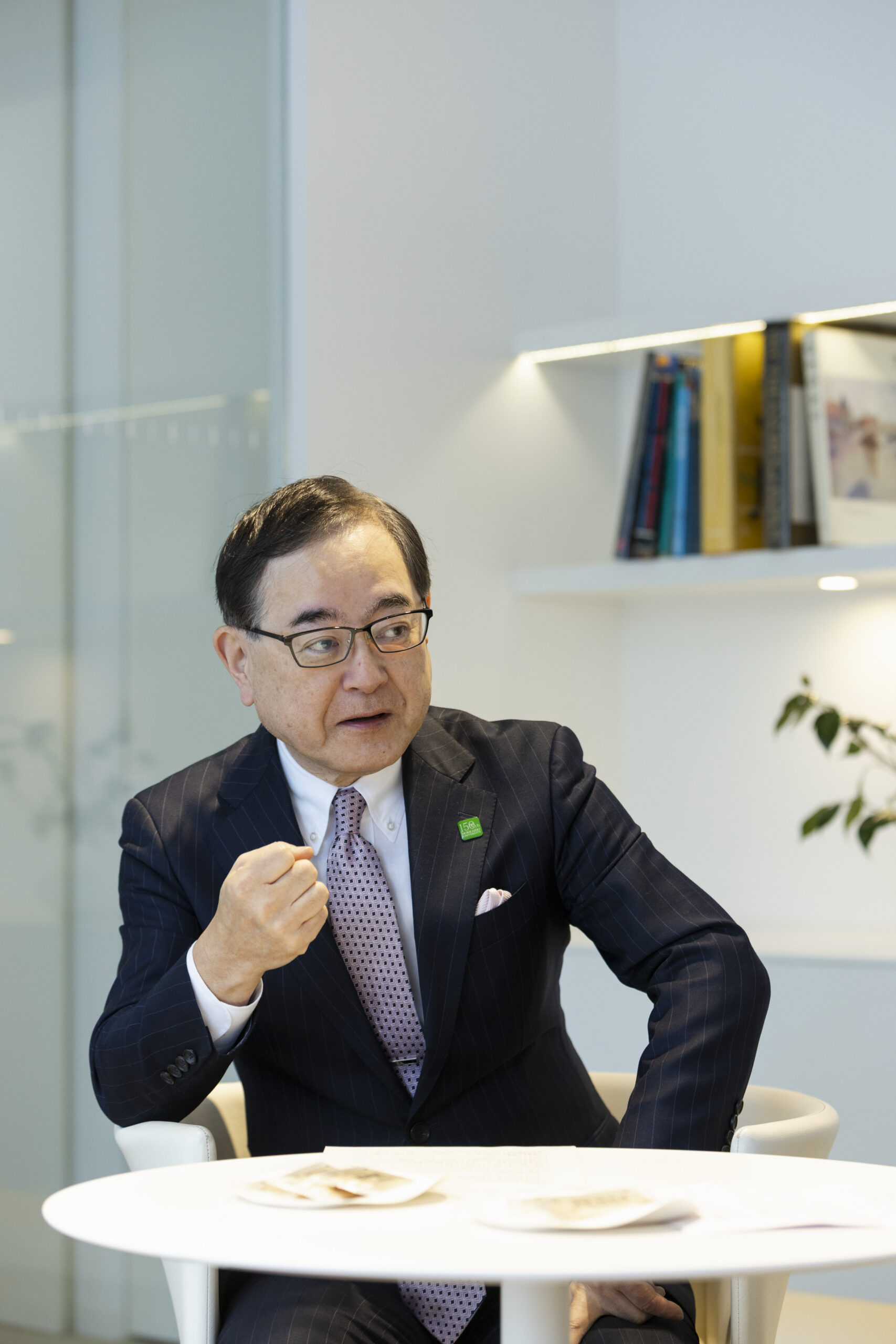
Naganuma: I graduated from university thanks to a scholarship. I wanted to go overseas, but I didn’t manage to go until the year after I got a job at the farm in Niikappu. I bought a $90 bus pass for unlimited travel for three months and traveled solo around the U.S., staying with host families. I couldn’t speak any English, but everyone was kind, and I fell in love with America. I hope today’s students will also look beyond their immediate surroundings.
Houkin: So, your backpacking experience influenced your life and led to supporting study abroad. What are your future goals?
Naganuma: I’ll leave expanding the confectionery business to my son and personally take on agriculture again—something I wasn’t able to be successful with when I was younger. As part of a project to redevelop abandoned farmland, I plan to raise six Jersey cows and a thousand chickens in Bankei, creating a new family-run farming model. Producing our own eggs and milk for the confectionery will also boost our branding.
Houkin: You’re tackling lots of different things, but it feels like they’re all connected by a frontier spirit.
Naganuma: While a portion of the sales from Sapporo Agricultural College is used to support education at Hokkaido University, I hope to see similar second and third initiatives emerge following our example. I believe it’s meaningful to continuously support students.
Houkin: It might actually be a model that seems possible but didn’t exist before. I hope it becomes a new form of industry–academia collaboration that values student support and human connections. Thank you very much for today.