
Rare footage of elusive sea-floor creatures and backward-swimming fish captured by compact video-acoustic system in Greenland
Researchers have deployed a portable, non-invasive monitoring system on the seafloor of a remote Greenlandic fjord to observe Arctic biodiversity without disturbing the ecosystem.
Arctic glacial fjords are hotspots of marine life, yet their seafloor environments remain some of the least explored regions on Earth. Their extreme remoteness and the technical challenges of deep-water observation have led scientists to rely on indirect measurements like sonar. However, these methods cannot visually verify animal behavior or identify specific species.
Now, researchers at Hokkaido University’s Arctic Research Center have developed a lightweight, cost-effective video-acoustic mooring system that can be used for direct observation in these harsh conditions.
In a study published in the journal PLOS ONE, the researchers detailed the successful deployment of the system at a depth of 260 meters in Inglefield Bredning, northwest Greenland. The device, which weighs less than 15 kilograms and fits into a single transport box, was designed to be “invisible” to marine life. By using a high-frequency video camera paired with hydrophones and red LED lights, which fall outside the visible spectrum of many deep-sea organisms, the team sought to record natural behaviors without the disruption of standard white lights, which can attract or repel animals.
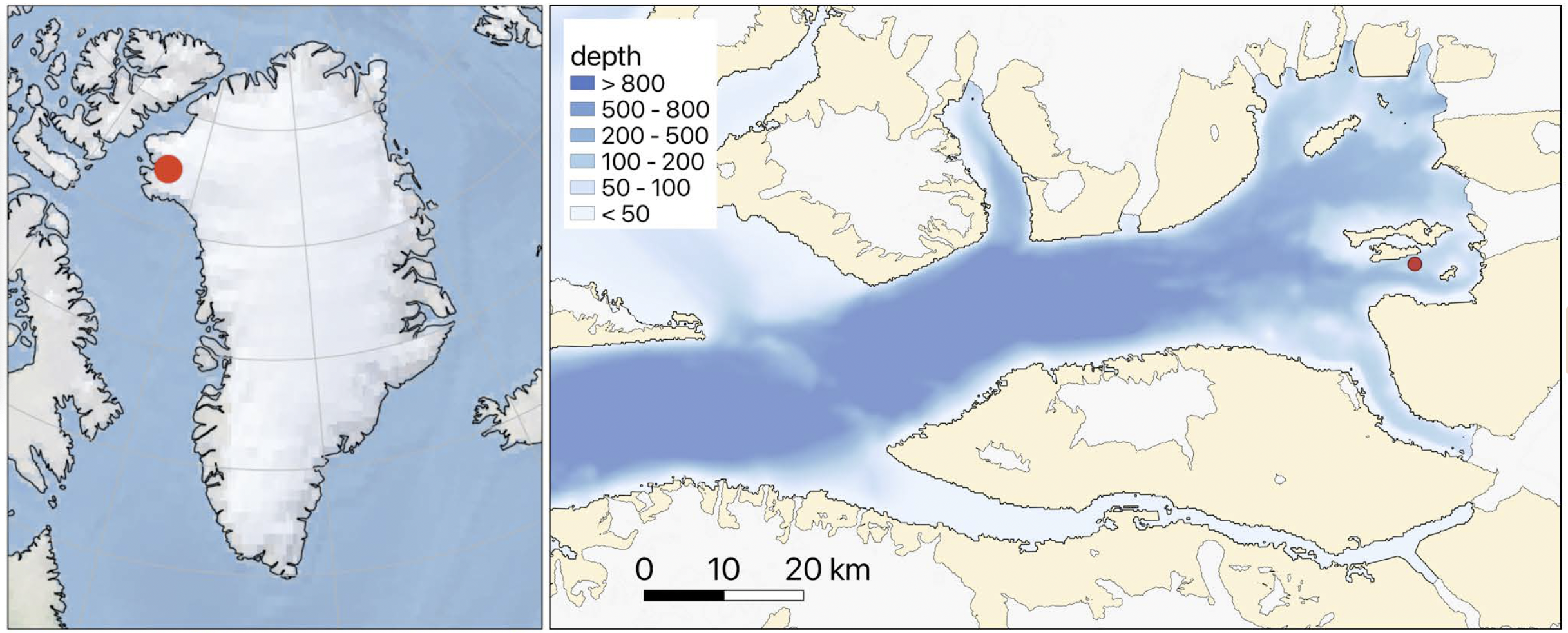
The resulting 37 hours of footage provided a rare window into the fjord’s hyperbenthos—the layer of life just above the seafloor. While the majority of the 478 organisms detected were small invertebrates, such as amphipods, copepods, arrowworms, and jellyfish, the system also captured striking footage and sounds of larger species. This included a snailfish exhibiting a peculiar backward swimming behavior, drifting with its tail curled, and the acoustic and visual presence of narwhals. Although the whales were not seen in full, the hydrophones recorded their ultrasonic sounds daily, and a narwhal tusk was captured just tens of centimeters from the camera lens.
The findings also highlight the dynamic nature of the deep-sea environment. The team observed that the transport of organic particles, known as marine snow, can double in concentration within hours, with the direction flipping every 6 hours in response to tidal currents.
By providing a scalable tool for polar research worldwide, this portable approach will significantly enhance the discovery of new species and the monitoring of environmental changes in the rapidly warming Arctic.
Original article:
Podolskiy E.A., Ogawa M., Hasegawa K., Tomiyasu M., Sugiyama S., Mitani Y.,Seafloor video-acoustic monitoring in a Greenlandic glacial fjord records hyperbenthos, backward-swimming fish, and narwhals. PLOS One, May 6, 2026.
DOI: 10.1371/journal.pone.0347193
Funding:
This study was supported by the Arctic Challenge for Sustainability research project (ArCS-III; JPMXD1720251001) and JSPS Grants-in-Aid for Scientific Research (KAKENHI 24K02093, 25H00452).
Contacts:
Associate Professor Evgeny A. Podolskiy
Arctic Research Center
Hokkaido University
Tel: +81-11-706-9074
Email: evgeniy.podolskiy[at]gmail.com
Megha Kalra
Public Relations & Communications Division
Office of Public Relations and Social Collaboration
Hokkaido University
Email: en-press[at]general.hokudai.ac.jp