


This article was first published in Japanese in Litterae Populi magazine (Spring 2026, Vol. 76)
KAWATE Kuriko
Second-year master’s student, Graduate School of International Media, Communication and Tourism Studies
In the Hokkaido University promotional video “What is your North Star?” released in December 2025, many viewers were likely struck by reporter Kuriko Kawate’s effortless English communication with international students.
“It doesn’t have to be perfect. As long as it gets the message across. English is a communication tool.”
Kawate, who speaks these words, also serves as the representative of the Hokkaido University-born venture Beeber Global. We heard about the journey that led her from her first encounter with English, through her challenges at university, to her path to entrepreneurship.
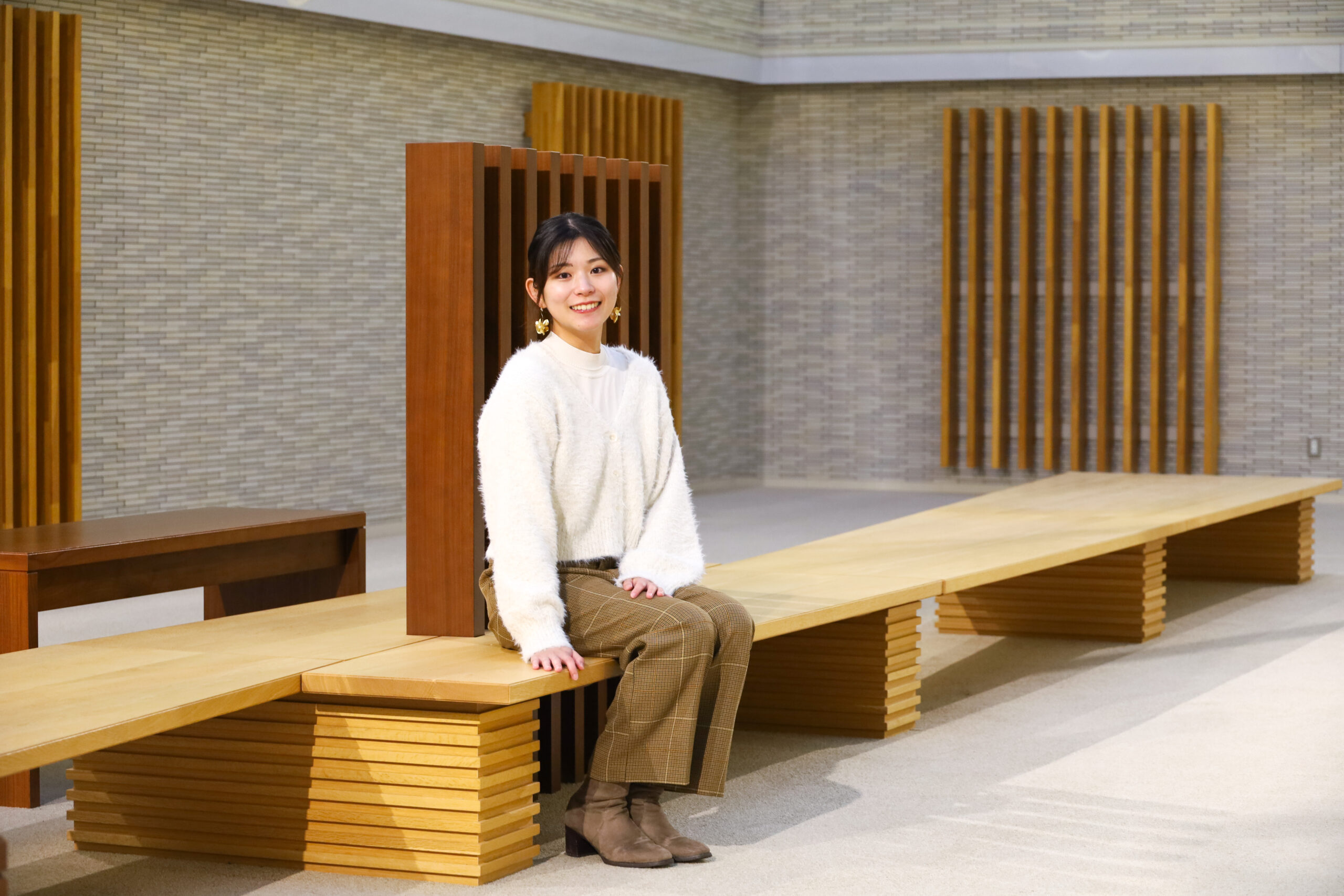
KAWATE Kuriko
Born in Ishikari City, Hokkaido. Enrolled in the School of Humanities and Human Sciences, Hokkaido University, in 2020. Currently enrolled in the Graduate School of International Media, Communication, and Tourism Studies, researching regional revitalization through tourism. Served as Campus Director of the Hokkaido University Organizing Committee for the international social entrepreneurship program, Hult Prize, for two years from 2023. Founded Beeber Global in 2022. As its representative, she connects international students at Hokkaido University with local communities and businesses, facilitating activities that rediscover the region’s appeal through international co-learning and multicultural coexistence.
When did you first become interested in English?
My parents loved foreign films, so I was exposed to English from a young age. By junior high school, I wanted to work in the film industry and thought, “I need English for that,” so I started studying. After entering the International Culture Department at Hokkaido Sapporo Intercultural and Technological High School, I immersed myself even more in English. I passed the Eiken Grade Pre-1 exam in my second year of high school and honestly felt satisfied, thinking, “This is good enough.”
But that changed completely when I attended a youth forum in South Korea. Students my age, whose native language wasn’t English, were confidently expressing their opinions in English. Meanwhile, despite having studied English, I couldn’t convey my thoughts well. The gap was shocking.
You entered Hokkaido University in 2020. What did you focus on during your university years?
My first year coincided with the pandemic, and classes didn’t start until May. I wanted to engage in international exchanges, but at first, I couldn’t do anything, which was frustrating. Near the end of my first year, I finally participated in an online study abroad program. There, I met peers who shared my desire to “create our own international exchange events,” so we started a volunteer group. We planned events like a presentation contest themed around the SDGs.
The person who supported this activity was Ms. Sangeetha Ratnayake, who was chairing the Hokkaido University Hult Prize Steering Committee at the time. Later, she asked me, “Why don’t you try helping with the operations too?” and I served as chair starting in my third year. Then, in 2022, I established Beeber Global to upgrade communication in Japanese society and contribute to solving regional issues.
What sparked your interest in entrepreneurship?
I was inspired by the mindset of the entrepreneurs I met through the Hult Prize. They were genuinely focused on “solving social issues and creating value” rather than just “getting into a good company,” and they seemed to genuinely enjoy developing those activities. Gradually, I started thinking, “I want to try that too.”
In Japan, international students who aren’t fluent in Japanese often struggle with paperwork and administrative procedures. Meanwhile, Japanese students are interested in international exchanges. What I felt at the Youth Forum was that the difference lay not in English proficiency itself, but in “how to use it” and “how to approach it.” So, I started thinking: couldn’t we create a space where people coexist more naturally, using English not as something to speak perfectly, but as a tool for communication? That’s when I realized English doesn’t have to be perfect.

Recently, we held workshops for Japanese high school and university students to tackle corporate challenges alongside international students. We prioritize learning through English over just learning English.
Lastly, do you have any words of encouragement for Hokkaido University students?
Don’t let your location limit you. Think about what you want to do. The answer might be found within the university, or it might be outside. You might feel lost or anxious at times, but once you decide on your path, just keep moving forward. Believe in the decisions you’ve made.